|
Getting your Trinity Audio player ready...
|
Trump’s protectionist policies have created winners and losers across continents, massive market volatility, and forced companies around the world to completely restructure their operations. This article examines the legal structure of tariffs, possible reasons for why they were imposed, the latest developments of tariffs as of August 20th, 2025, and the latest developments on tariffs at the Alaska Summit. Underlying it all is Trump’s trademark slogan, “Make America Great Again,” driving his aggressive push to restore U.S. economic dominance through tariffs and trade restrictions.
Introduction
Donald Trump’s return to the White House in January 2025 has sparked the most aggressive trade war since the Great Depression, significantly altering global commerce and causing unprecedented economic disruptions. Tariff rates currently average 18.6%, the highest since 1933 (59.20%).
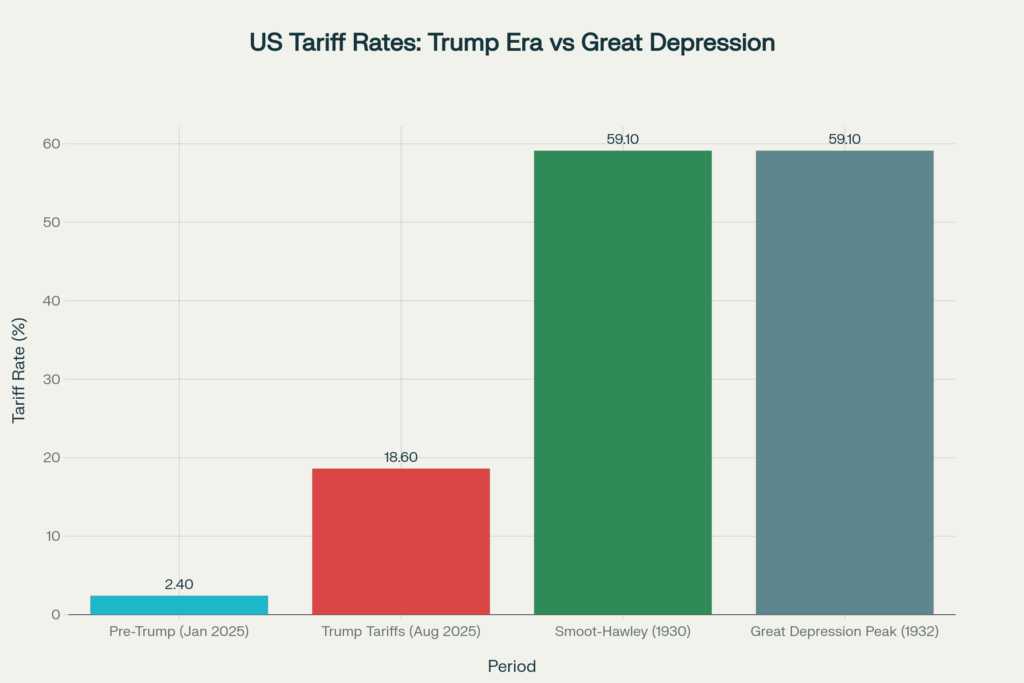
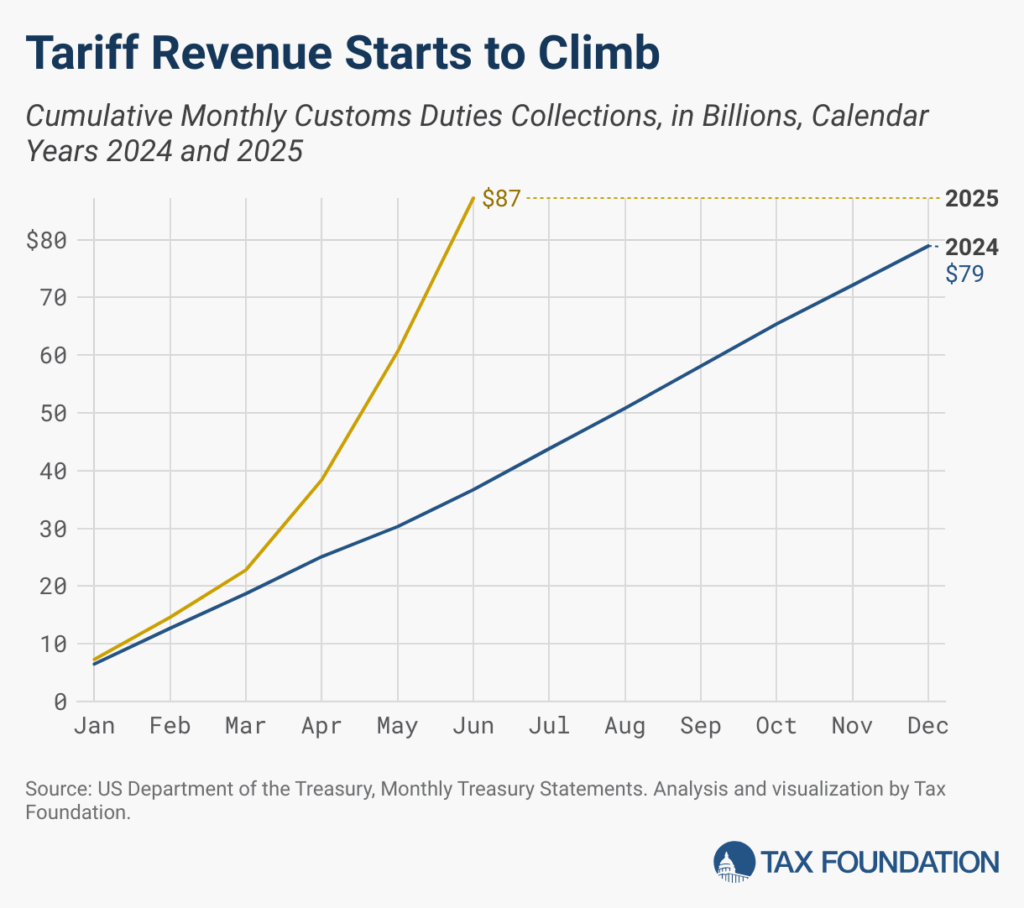
Trump’s 2025 tariff offensive marks a significant departure from decades of free trade, with over 60 countries facing punitive tariffs ranging from 10% to an unprecedented 125%. The administration collected a record-breaking $27.7 billion in tariff revenue in July 2025 alone, representing a staggering 273% increase year on year. After months of delay, higher tariffs that President Donald Trump had vowed to impose on goods imported from dozens of countries went into effect on Aug. 7. Just before the newest tariffs went into effect, Trump wrote on Truth Social, in all capital letters: “RECIPROCAL TARIFFS TAKE EFFECT AT MIDNIGHT TONIGHT! BILLIONS OF DOLLARS, LARGELY FROM COUNTRIES THAT HAVE TAKEN ADVANTAGE OF THE UNITED STATES FOR MANY YEARS, LAUGHING ALL THE WAY, WILL START FLOWING INTO THE USA.”
‘IEEPA’ explained
The International Emergency Economic Powers Act (IEEPA) grants the President sweeping authority to regulate commerce after declaring a “national emergency” in response to threats originating abroad. Under IEEPA, the President may:
- Freeze Assets: Block U.S. persons from accessing targeted foreign assets and transactions.
- Impose Trade Controls: Restrict imports, exports, and financial dealings with specified countries, entities, and individuals.
- Issue Regulations: Delegate broad powers to the Treasury’s Office of Foreign Assets Control (OFAC) and Commerce’s Bureau of Industry and Security (BIS) to craft detailed sanctions rules.
Sanctions vs. Tariffs
- Sanctions are punitive measures aimed at altering a foreign government’s behaviour—commonly used against human rights violators or national security threats (e.g., Iran, Venezuela). They typically prohibit U.S. persons from engaging in all dealings with sanctioned targets and freeze assets within U.S. jurisdiction.
- Tariffs are duties on imports meant to protect domestic industries or generate revenue. Under Trump, IEEPA has been repurposed to impose blanket tariff increases on countries deemed national security threats (e.g., China, Russia) rather than tailored sanctions on specific actors.
Under IEEPA and related trade statutes, the President wields multiple authorities to impose tariffs, sanctions, and trade restrictions:
- Section 232 (Trade Expansion Act of 1962)
- Allows tariffs if imports threaten U.S. national security.
- Used to impose 25% steel and 10% aluminium duties in 2018 and expanded to critical minerals and oil.
- Section 301 (Trade Act of 1974)
- Targets unfair trade practices (e.g., IP theft, forced technology transfer).
- Basis for 2018–2020 China tariffs (up to 25% on $370 billion of goods), recently reactivated under IEEPA’s emergency declaration.
- Section 232 Emergency Authorities (IEEPA)
- Permits unilateral tariff increases on “critical infrastructure” goods during national emergencies.
- Trump invoked IEEPA to impose blanket 10–125% “reciprocal tariffs” on over 60 countries, bypassing congressional approval.
- Section 201 (Trade Act of 1974 – Safeguards)
- Implements temporary import relief (safeguards) for industries suffering serious injury from surges.
- Rarely used; discussions are underway to apply safeguards to solar panels and electric vehicles.
- OFAC Sanctions (IEEPA Delegation)
- Blocks U.S. persons from dealing with sanctioned countries/entities (e.g., Russia, Iran).
- Tariffs differ from sanctions: sanctions freeze assets and prohibit all transactions, while tariffs impose duties collected at customs.
Why is Trump Imposing Tariffs and a Trade War?
- Eliminating the Trade Deficit Crisis: Trump’s primary justification centres on America’s $1.2 trillion trade deficit in 2024, with China alone accounting for $295.4 billion. His administration views this not as natural economic flow but as systematic foreign exploitation that has “hollowed the U.S. manufacturing base” and reduced America’s defence-industrial capacity to dangerous dependence on adversaries.
- Revenue Generation Revolution: Trump believes tariff revenue could replace federal income taxes, referencing 1870-1913 when tariffs were America’s primary revenue source. “There is a chance that the money is so great that it could replace income tax,” he stated. Monthly collections have tripled from $7 billion to $25 billion, with 2025 revenue reaching $129.2 billion—a 130.9% increase. However, this represents only a fraction of the $2.4 trillion from income taxes.
- National Security and Manufacturing Revival: The administration argues that trade deficits create dangerous vulnerabilities, citing COVID-19 supply chain disruptions and reduced domestic steel production serving only 3% of military needs. Trump promises tariffs will bring manufacturing jobs back to America’s heartland, reversing deindustrialisation through “Made in America” policies. “If they complain, if you want your tariff rate to be zero, then you build your product right here in America”, he quoted in April 2025. “For years, hard-working American citizens were forced to sit on the sidelines as other nations got rich and powerful, much of it at our expense. But now it’s our turn to prosper.”
- Ideological Foundation: Economic Nationalism: Trump fundamentally rejects the multilateral WTO system’s “positive sum game” theory in favour of zero-sum competition where America wins at others’ expense. His “reciprocal trade” principle demands matching foreign tariffs: “Whatever tariffs they impose on us, we will impose on them”.
- Geopolitical Leverage and China Competition: The China tariff war transcends trade, encompassing strategic rivalry over intellectual property theft, currency manipulation, and subsidies. Trump uses “weaponised tariffs” as political coercion tools, extending beyond trade to punish countries for insufficient defence spending or—in India’s case—purchasing Russian oil.
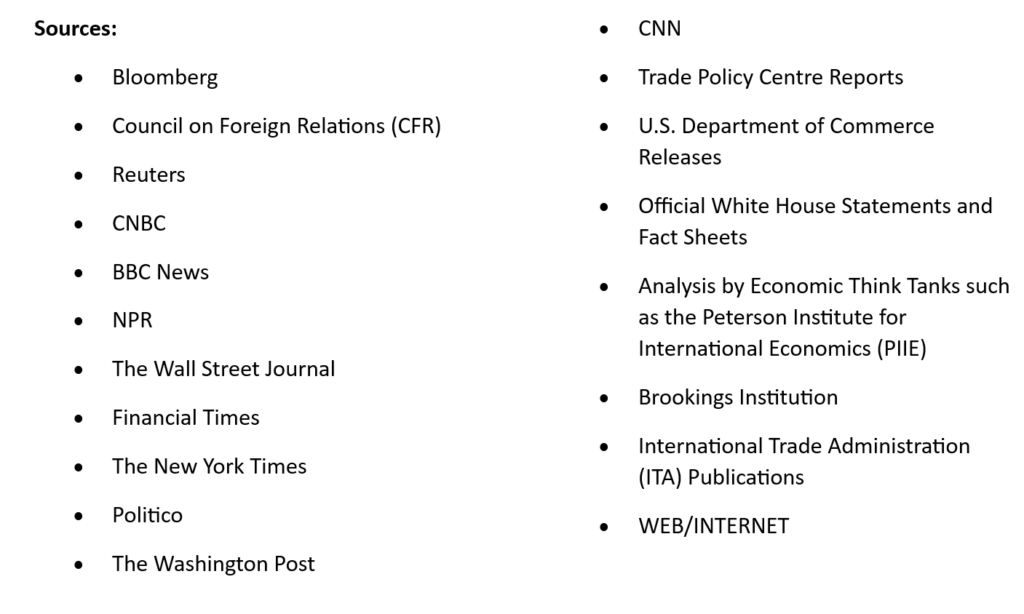
- Historical Nostalgia: Trump draws inspiration from America’s 1870-1913 protectionist era, when high tariffs coincided with rapid growth. His philosophy reflects nostalgia for 1950s-60s manufacturing dominance, believing tariff protection can restore middle-class prosperity through factory jobs, as reported by Bloomberg.
Inside the Mind of Trump
Donald Trump’s trade strategy combines economic nationalism, transactional bargaining, and performative politics. Viewing trade as a zero-sum contest, he believes tariffs are “the most beautiful word” in economics, using them to force trading partners into concessions. His modus operandi mirrors real estate dealmaking: ultimatums over compromise. The “reciprocal tariffs” doctrine matches any foreign duty with equivalent U.S. tariffs, sidelining multilateral diplomacy for direct brinkmanship. ” Tariffs are going to make us rich as hell. It’s going to bring our country’s businesses back that left us.”
Moreover, Tariffs also serve as political theatre, reinforcing Trump’s image as tough on foreign competition. Social-media posts increase media attention and energise his position, often overshadowing nuanced policy debates. Under the International Emergency Economic Powers Act, he uses emergency powers to impose duties unilaterally, signalling a willingness to bypass Congress and the WTO.
Fundamentally, Trump’s approach is ideologically simple: identify perceived threats to U.S. prosperity, apply maximum pressure, and claim victory when opponents make any concession. This tactic yields episodic headlines and negotiating leverage, reshaping global commerce around his “America First” vision rather than building enduring trade frameworks.
What are the Latest Tariffs Imposed by the US on different countries?
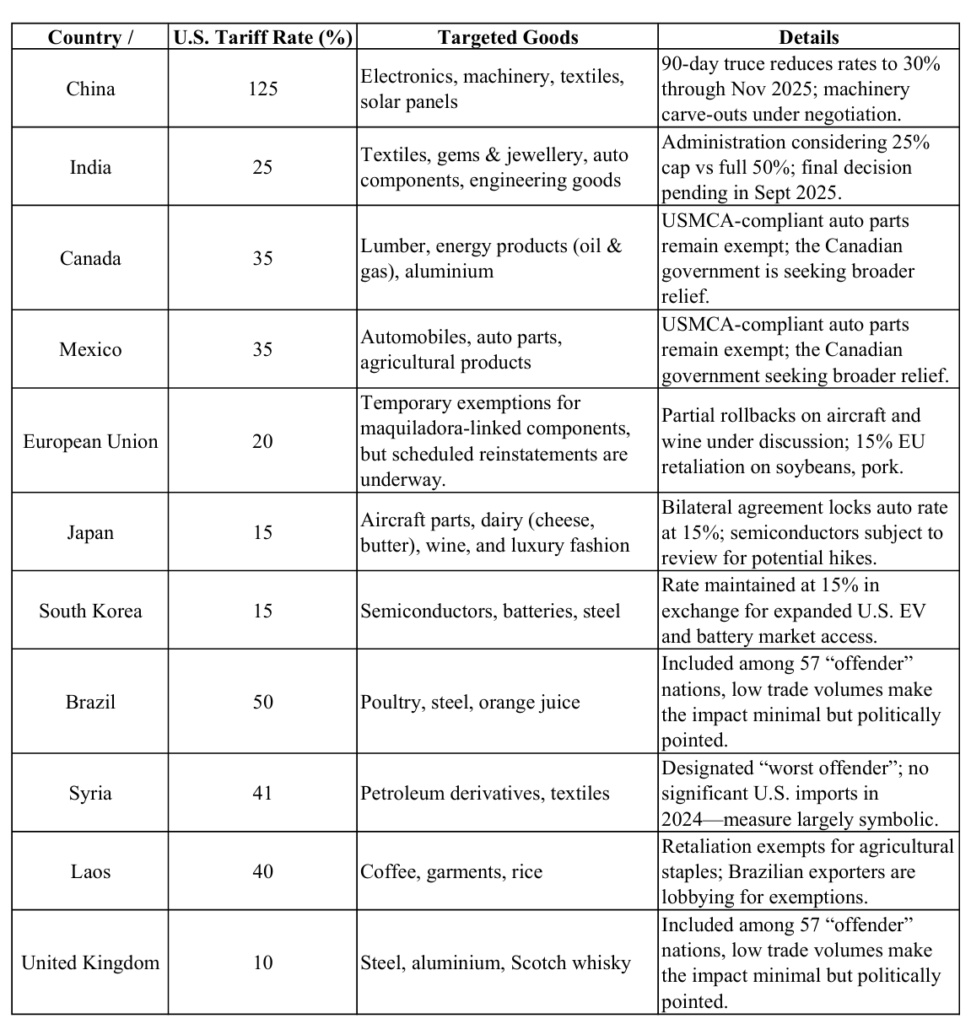
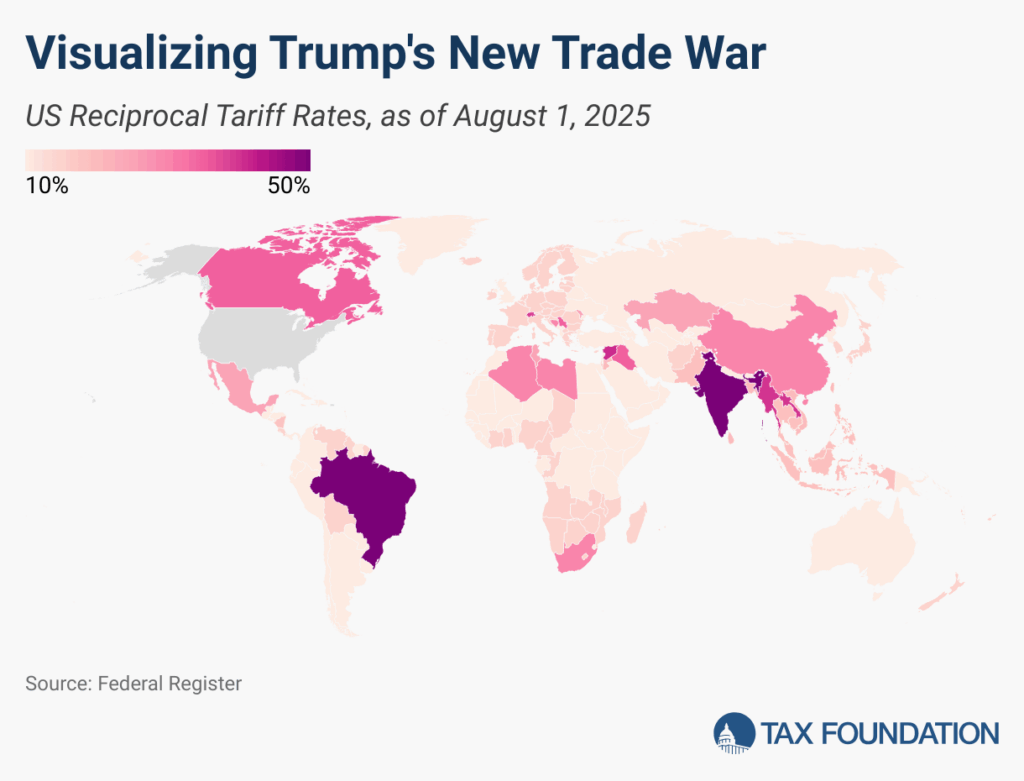
Trade Blocs and Deals Finalised by the US and Implications for the Economies
- United States–Mexico–Canada Agreement (USMCA): In force since 2020, under threat of renegotiation. US “reciprocal” duties apply broadly, but USMCA-compliant auto parts retain limited exemptions. Uncertainty has delayed investments at Mexican plants and pressured U.S. suppliers such as Lear Corporation.
- U.K. Steel & Aluminium Carve-Out: June 2025 deal reducing tariffs from 50% to 20% on U.K. steel and aluminium in exchange for a $12 billion U.S. defence-procurement pledge. BAE Systems and Rolls-Royce have locked in initial contracts.
- South Korea Semiconductor Accord: March 2025 agreement fixing a 15% tariff on Korean semiconductors, contingent on Samsung and SK Hynix doubling U.S. fab investments by 2027. Micron and GlobalFoundries stand to benefit from expanded capacity.
- Japan Partial Accord: April 2025 package capping auto duties at 15% and machinery at 10% in return for Japanese commitments to buy an additional $2.5 billion of U.S. wheat and beef annually.
- EU Aircraft Truce: July 2025 suspension of U.S. 10% and EU 15% aircraft tariffs for one year, pending WTO litigation on Airbus-Boeing subsidies.
- Vietnam & ASEAN Framework: May 2025 memorandum reducing Vietnam’s rate to 20% (from 40%), conditioned on raised labour standards for U.S. apparel sourcing by end-2026. PVH Corp. and Nike are adjusting supply chains accordingly.
- Kenya AGOA Extension: Extension of African Growth and Opportunity Act benefits through 2028 for Kenyan textiles, preserving duty- and quota-free access for U.S. brands like Gap Inc. and H&M.
The Alaska Summit and Key Developments on Tariffs
- India Oil Tariff Clarification
President Trump reiterated that India’s continued imports of Russian crude, roughly 35% of total oil purchases, would trigger the administration’s 25% punitive surcharge on products such as textiles, auto components, and engineering goods, bringing total duties to 50% by August 27, 2025. However, after the talks, President Donald Trump made a comment saying, “Maybe I won’t Have To Do It (impose additional 25% tariff)”. Further details are awaited as the deadline approaches. - China Truce Extension
A critical breakthrough saw China’s existing 125% tariff on US goods reduced to 30% for 90 days, expiring on November 16, 2025. The pause applies to key sectors such as heavy machinery, semiconductors, and pharmaceuticals, and is contingent on Beijing’s participation in Ukraine conflict de-escalation talks. In exchange, the United States agreed not to carry out threatened escalations, demonstrating that geopolitical negotiations can result in temporary tariff relief. - No New Oil Sanctions
Section 232 tariffs were threatened by President Trump on Russian oil and natural gas as part of his broader trade measures. Although during the Alaska Summit, both the U.S. and Russia agreed to delay these tariffs to avoid disruption in the global energy supply. Brent crude prices dropped by 4% on the summit’s first day, caused by due to the informal agreement. It also showed the U.S. was willing to balance tough trade actions with maintaining market stability amid ongoing geopolitical tensions. - Supply-Chain Dialogue
Reuters reported “The Alaska Summit led to the creation of a joint task force between the U.S. and Russia to coordinate investments and standards in semiconductor and critical mineral supply chains, aiming to reduce the impact of escalating tariffs and trade tensions on strategic industries.”. While details remain preliminary, the dialogue represents a novel use of diplomatic channels to mitigate tariff-driven disruptions in strategically vital industries.
THE TIMELINE OF EVENTS
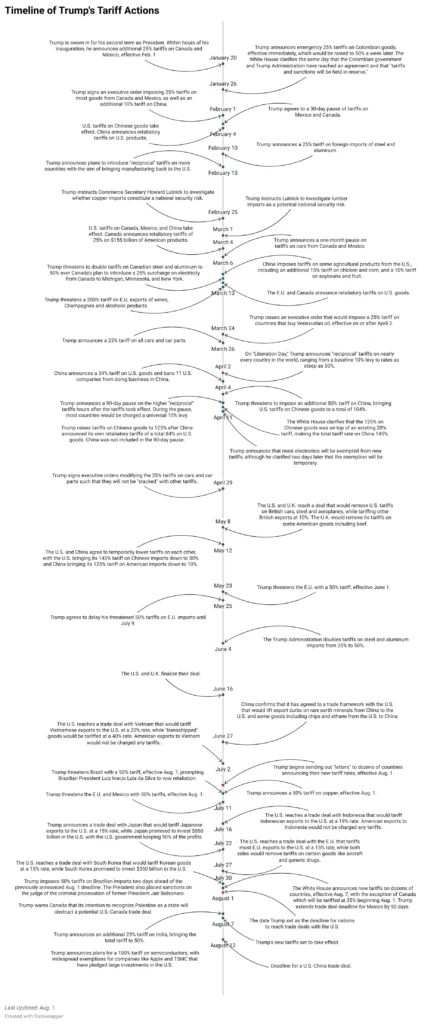
In conclusion to Part 1 of the “Trump Presidential Saga” series, this article provided an in-depth examination of the unprecedented tariffs, legal powers, trade deals, and diplomatic moves that have defined the Trump administration’s 2025 trade strategy. By mapping the scope and mechanics of these sweeping policy shifts, we set the stage for understanding their far-reaching consequences. Part 2 will deliver a detailed analysis of the economic impact of these tariffs on both the United States and India, dissecting how industries, jobs, and growth trajectories have been altered in the wake of this trade war.
The information presented herein is based on thorough research and reliable sources to the best of the author’s knowledge. However, it is intended solely for informational purposes and does not constitute professional financial, legal, or investment advice. Readers should consult qualified professionals before making any decisions. “The Financial Brief” is not responsible for any outcomes resulting from reliance on this content.
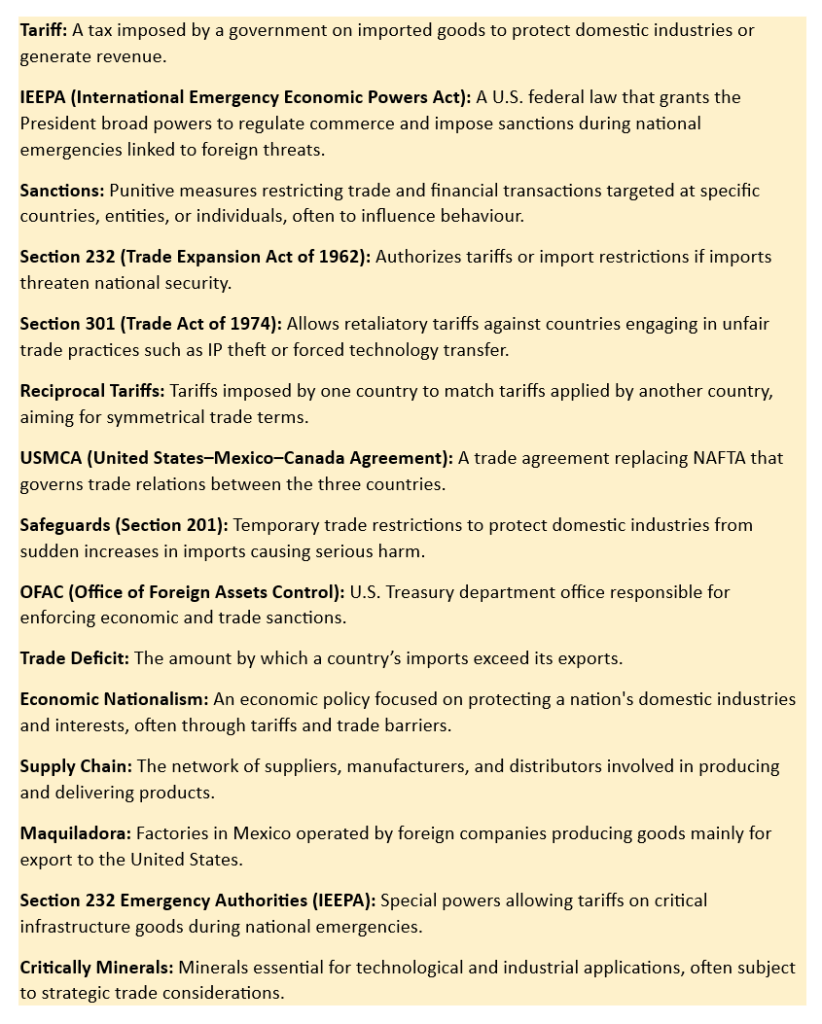
Glossary:
Very well written, everything has been put up in once place. Good Going